 on Google


Wildlife and Birds – Kenya safari animals
Around 10% of Kenya’s landmass (582,646 km²) is protected for conservation. Each region has unique ecosystems, including coastal reefs, forested peaks, vast savannahs, and semi-arid areas.
These habitats are home to a plethora of wildlife. Below, we explore some top destinations to spot your favourite Kenya safari animals and birds.

WHERE TO SEE THE BIG FIVE IN KENYA
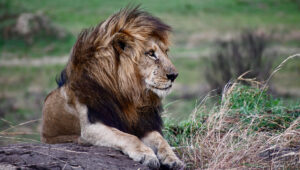
Lion
Lions are the kings of the animal kingdom and Kenya’s national animal. Sadly, the global lion population is declining (23,000 remain), and they have become extinct in some African countries due to habitat loss. However, Kenya’s lion population was discovered to have increased by 25% in 2021 to 2,489 – a positive development.
- Six prides of lions, totalling 72 individuals, live at Ol Pejeta Conservancy. Guests can accompany the lion tracking team to monitor the lions’ positions.
- Home to 420 lions, the Masai Mara National Reserve has one of the highest densities of lions in Africa.
- Meru National Park has 80 lions, made famous by George and Joy Adamson, who set their hand-reared lioness, Elsa, free in this park.
Leopard
Leopards are arguably the hardest to spot of the Big Five due to their solitary nature, camouflage, and preference for wooded areas. Sadly, their population is also believed to be declining.
- Samburu National Reserve, with beautiful scenery, is one of the best places to spot leopards due to the exceptional habitat provided by the Ewaso Nyiro River.
- The Mara-Serengeti ecosystem is an excellent destination for a cross-border safari and one of the best places in East Africa to spot leopards.
- Due to the dense forests, leopards are difficult to spot in Aberdare National Park. However, this park is home to rare black or melanistic leopards.
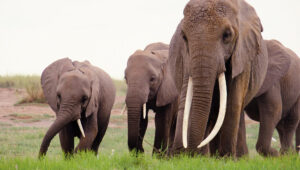
Elephant
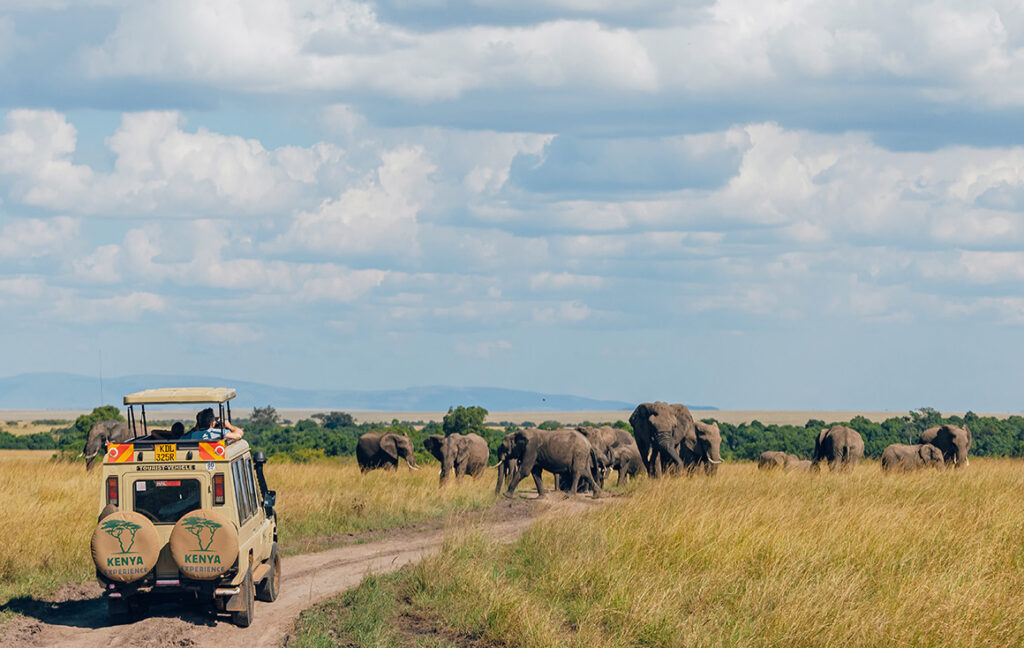
Kenya is a great place to see endangered elephants. Despite the overall decline of elephants in Africa, since 2021, Kenya has reported a 5% annual increase in their elephant population, which currently stands at 36,000.
- There are 12,500 elephants in Tsavo East and West National Parks. The elephants here have a red colouration due to dusting themselves with iron oxide-rich soil to protect themselves from the sun and parasites.
- Amboseli National Park is home to 750 resident elephants, making it an excellent destination to observe these magnificent creatures. It also serves as a convenient stopover en route to Tsavo and the tropical coastline.
- Nairobi National Park allows visitors to observe orphaned elephants being bottle-fed at the Sheldrick Wildlife Trust’s Elephant Orphanage. There are no free-roaming elephants in Nairobi National Park since the habitat is too small.
Rhino
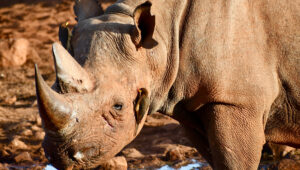
Kenya is home to Black and White rhinos. Rhino horns are made of keratin, the same protein that forms human hair and nails. Poaching for their horns has led to a collapse in their population. However, their numbers are slowly increasing thanks to multiple innovative projects.
- Nairobi National Park, fondly known as Kifaru Park (Rhino Park), is a great place to see them with the city profile on the skyline.
- Lewa Wildlife Conservancy began as a rhino sanctuary and now protects 14% of Kenya’s rhino population and manages several other inspiring projects.
- Ol Pejeta Conservancy is a pioneering wildlife conservancy with a rhino sanctuary that protects over 100 rhinos, including the last two Northern White rhinos.
Buffalo
There is only one species of buffalo, but it has four subspecies. These large, ox-sized animals have curved horns and an aggressive nature. Sadly, their population is listed as threatened, and their numbers continue to decline.
- Lake Nakuru National Park is home to rhinos, lions, and buffaloes. The park’s beauty, featuring a colourful lake and yellow fever trees, makes it a perfect location for photographing these iconic animals.
- The Masai Mara National Reserve supports large herbivore populations, including 62,000 buffaloes and 2,500 elephants.
- Hells Gate National Park offers a range of outdoor activities, such as mountain biking, hiking, and rock climbing. While mountain biking through the park, visitors can see antelopes, zebras, buffaloes and more.
WHERE TO SEE THE NORTHERN FIVE
The Northern Five are a group of beautifully patterned animals found in northern Kenya. The five species are the Reticulated Giraffe, Beisa Oryx, Somali Ostrich, Grevy’s Zebra, and Gerenuk antelope.
Unfortunately, their populations are declining, making it even more special if you spot all five. Kenya safari animals such as these Northern Five provide unique sightings for wildlife enthusiasts.
Reticulated Giraffe
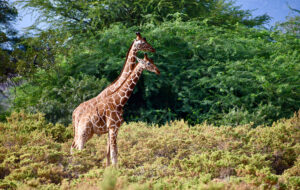
The giraffe population has decreased by 30% since the 1980s. Nine sub-species of giraffes are found in sub-Saharan Africa, and the Reticulated giraffe is one of them.
Thanks to its dark-red block-like patches and distinctive white separating lines, it is easily recognisable. It is native to Ethiopia, Somalia, and northern Kenya. Unfortunately, it is an endangered species, with only about 11,000 individuals remaining.
- Samburu National Reserve is a great place to see reticulated giraffes in relatively large groups.
- Lake Nakuru National Park has a small population that was translocated for protection, which is another reason to visit this beautiful park.
- Ol Pejeta Conservancy, with views of Mount Kenya, is another excellent place to see these beautiful Kenya safari animals.
Grevy’s Zebra
Grevy’s Zebra is the largest of the three species, including the plains and mountain zebras. Found in Ethiopia and northern Kenya, it is tall with larger ears and heads, and its tight, thin stripes distinguish it from other zebras.
Interestingly, no two zebras have the same stripe pattern, making it as unique as a human fingerprint. Sadly, the population of Grevy’s Zebra has fallen from 15,000 to 2,800, leading to their endangered classification.
- Lewa Wildlife Conservancy protects 12% of Kenya’s Grevy’s Zebra population and aims to establish a predator-proof breeding area for these zebras.
- Meru National Park is a secluded destination with a thriving wildlife population, including Grevy’s zebras.
- Samburu National Reserve is where you are almost guaranteed to see them as they are prominent Kenya safari animals in this park.
Gerenuk
The Gerenuk, also known as the giraffe-necked antelope, has decreased in population by 25%. Male Gerenuks have small curved horns, while females are hornless. They can often be seen standing on their hind legs, stretching out their long necks to reach the lowest hanging leaves.
These antelopes live in arid regions and typically form small groups of two to six individuals. Their habitat ranges from the Horn of Africa to northeast Tanzania.
- Samburu National Reserve offers the perfect environment for these antelopes.
- Tsavo East and Tasvo West National Parks are great places to spot Gerenuk among a plethora of other Kenya safari animals.
Oryx
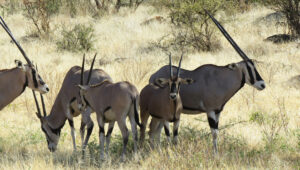
The East African, or Beisa Oryx, is a graceful antelope with elegant black markings, a distinctive face mask, and straight horns pointing backwards. Sadly, they are endangered, with only 13,000 individuals left.
Most commonly associated with Namibia, Oryx can also be found in the semi-arid regions of Southern Sudan, Ethiopia, Northern and Eastern Kenya, and Northeastern Tanzania.
- If you’re interested in seeing oryx in their natural habitat, Samburu National Reserve and Meru National Park are excellent places to visit.
- In addition, Tsavo West National Park is home to a sub-species called the Fringed-eared Oryx. These animals look similar but are distinguished by their fawn-like colouring. Spotting them adds to the variety of Kenya safari animals.
Somali Ostrich
The Somali ostrich is a flightless bird and can be identified by its blue neck and thigh skin, which appears bright blue during the mating season in males. They are usually seen in small groups and can run over 70 kilometres per hour.
Unfortunately, like other members of the Northern Five, their population is decreasing, and they are now listed as vulnerable.
- If you want to see these flightless birds, the best places to visit are Kenya’s northern parks, such as Meru National Park, Samburu National Reserve, and Lewa Wildlife Conservancy. The Somali ostrich is among the unique Kenya safari animals you should look out for.
LIST OF WILDLIFE IN KENYA - MAMMALS
Wildebeest and other antelopes
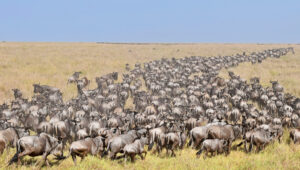
There are 91 antelope species in Africa, of which 19 reside in Kenya. Although wildebeest and antelopes are commonly seen in many national parks, they can be overlooked. However, there are some unique antelope to spot during your visit.
The Eland is the largest, while the Dik-dik are some of the smallest. The Oryx, Greater and Lesser Kudu are the most elegant, while charismatic Topi and Hartebeest are arguably the least.
The waterbuck is fond of water; the bushbuck prefers to inhabit bushy areas, while the Klipspringers reside in rocky habitats. The Impala, Thomson’s Gazelle, and Grants Gazelle are the most numerous, whilst the rarest include the Eastern Bongo and Hirola.
Hyena
There are four species of hyenas: the spotted hyena, brown hyena, aardwolf, and striped hyena; unfortunately, their populations are decreasing. The most common species is the spotted hyena, which can be identified by its round ears and spotted coat, which are more noticeable in young hyenas.
They are both predators and scavengers and can be seen hunting alone or in groups of up to 50 individuals.
They have a matriarchal social society, with the alpha females often being larger than males. They produce a whooping call, which you can hear miles around at night.
The Masai Mara National Reserve, Amboseli National Park and Tsavo National Parks are good places to spot them.
Warthog
Warthogs are fascinating Kenya safari animals known for their distinctive tusks and wart-like facial protrusions. These animals are surprisingly fast runners and use their speed to escape predators.
They are often seen in family groups called sounders, grazing on grass and roots.
- The Masai Mara National Reserve offers frequent sightings of warthogs, especially in open grasslands where they graze.
- Nairobi National Park, near Kenya’s capital, is home to a healthy population of warthogs you can easily spot during game drives.
- Amboseli National Park, with its stunning views of Mount Kilimanjaro, also provides opportunities to see warthogs in their natural habitat.
Cheetah
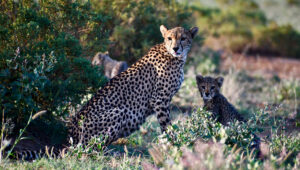
The Cheetah is a stunning and graceful cat, acclaimed for being the swiftest animal on the savannah. It is distinguishable from a leopard due to its long, slender body and tail and black tear stains on their face.
Unfortunately, their population is dwindling, and they are currently classified as vulnerable, with only 6,517 cheetahs remaining in the world.
In Kenya, there are approximately 716 cheetahs. Despite being exceptional hunters, their slender size, which enables them to run so fast, also places them in danger, as they frequently lose their prey to stronger predators.
Outstanding locations to observe them include Amboseli National Park, the Masai Mara National Reserve, and Ol Pejeta Conservancy.
Hippos
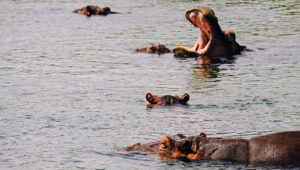
Hippos are the third largest land mammal of all Kenya safari animals, surpassed by elephants and rhinoceros.
Unsurprisingly, they make their homes in rivers and lakes, given that their closest living relatives are cetaceans – marine mammals such as porpoises, whales, and dolphins.
Dominant males (bulls) control a territory of water and up to thirty cows and calves. Male hippos weigh up to 1,500 kg (3,300 lb), while females are slightly smaller, at 1,300 kg (2,900 lb).
During dawn and dusk, you can observe them grazing on grassy banks. However, hippos are dangerous on land. Despite their size, they are fast runners, reaching speeds of 30 km/h (19 mph).
Sadly, even hippos are facing threats from habitat loss and poaching.
Spot them at Meru National Park, Lake Nakuru National Park and Lake Naivasha.
BIRDS IN KENYA
Flamingos
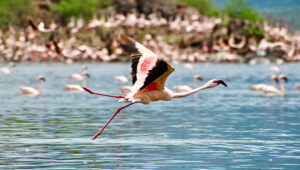
Kenya is home to Greater and Lesser Flamingos. Although these birds may not be considered the most beautiful when seen individually, they create a stunning spectacle when they gather in large groups, known as flamboyance. They can be seen moving in perfect synchronicity across a lake or taking flight in unison.
The Kenyan Lakes System, which includes Lake Nakuru, Elementaita, and Bogoria in the Rift Valley, provides habitats for 75% of the world’s Lesser Flamingo population and one of the largest breeding colonies of Great White Pelicans.
Consequently, these lakes are great places to see Flamingos and Pelicans.
Grey Crowned Crane
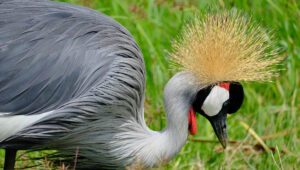
The Grey-Crowned Crane is a stunning bird on land, but it’s even more breathtaking when it takes flight. Its vast 2m wingspan allows this 3.5 kg (7.7Ib) bird to take to the sky.
You can often spot them near rivers and lakes, often in pairs of two, but sometimes in flocks ranging from 20 to 150 individuals. With its golden crown of upright feathers, it looks genuinely regal.
Unfortunately, these magnificent birds, the national bird of Uganda, are currently endangered due to habitat loss.
Pelicans
Kenya is home to two species of pelicans – the Great White Pelican and the Pink-backed Pelican. These majestic birds are a sight to behold, with males weighing 9kg to 15kg. Despite their massive size, they can easily take to the sky.
In flight, you can spot a dark line across their wingtips that contrasts beautifully with their white bodies and huge yellow-beaked heads tucked backwards aerodynamically into their bodies.
Watching them land is just as mesmerising as watching them take off, as they use their paddle-like feet as brakes to skim to a stop.
Kori Bustard
The Kori Bustard is another impressive bird native to the East African savannahs, including the Kenyan wildernesses. It is one of the heaviest flying birds in the world, with males weighing up to 18kg (40 lbs).
The Kori Bustard has a distinctive appearance, with grey-brown plumage, black and white striped wings, and a long neck that it uses to hunt insects and small vertebrates.
The Kori Bustard is a famous sight among birdwatchers and wildlife enthusiasts.
Lilac breasted-roller
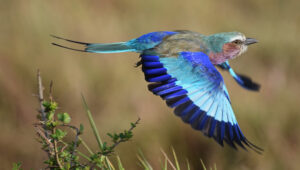
The lilac-breasted roller is a medium-sized bird native to the savannahs of East Africa and is known for its vibrant colours. Its distinctive chest is a brilliant lilac colour contrasting with its blue-green back and wings.
The bird is easily recognisable when perched on tree branches or in flight, where its colours are most vivid and striking. It feeds mainly on insects, and when hunting, it will swoop down from its perch, diving and rolling in the air to catch its prey.
They are regularly seen in savannah ecosystems, such as the Masai Mara.
DISCOVER EXCLUSIVE KENYA SAFARIS



OUR EXPERT ADVICE
PICK THE RIGHT PARKS TO VISIT AT THE RIGHT TIME
Not every safari animal can be found in every park.
Our country experts are passionate about East Africa and can guide you in incorporating the right destinations you need to make specific wildlife sightings a reality.
Contact us for a no-obligation conversation.


Experience Kenya with us
Speak to one of our local advisors
x
Let's start planning your trip!
We will get back to you within 2 working days.