 on Google









Sign up for our newsletter
"*" indicates required fields

A guide to climbing Mount Kenya, the most beautiful mountain in East Africa
Mount Kenya climbing tours to the peaks of the second-highest mountain on the African continent, is on the bucket list of many travellers and a fantastic trekking adventure for nature lovers.
Mount Kenya has diverse wildlife, endemic species, and stunning landscapes. It is a cherished mountain to Kenyans and is protected as part of the Mount Kenya National Park. Moreover, local people revere it as the home of their gods, UNESCO recognises it as a world heritage site, and the mountain even inspired the country’s name.
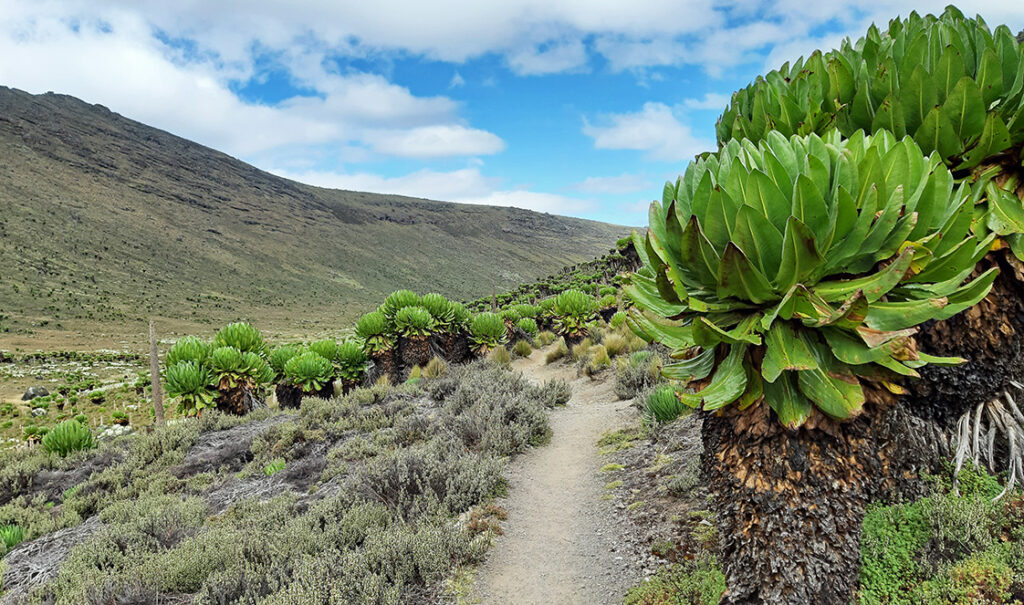
On Mount Kenya climbing tours, you will hike through the lower slopes’ thick montane and bamboo forests, where zebras and eland antelopes often graze. Passing babbling brooks and dark blue mountain lakes, you might be lucky to spot our mountain’s big brother, Mount Kilimanjaro, in the distance.
This ancient and extinct volcano’s glacier-covered peaks include Batian (5,199m), Nelion (5,188m), and Point Lenana (4,985 m). Whether you are an experienced climber or a novice hiker, Mount Kenya has a peak for you.
If you don’t have climbing experience, you can trek to Point Lenana by ascending one of many routes and returning via another. Adventure seekers aiming for Point Lenana can opt for the Naro Moru route, which features the world’s highest via Ferrata, a section with fixed lines and rungs to aid climbers. Nonetheless, easier routes also exist for your Mt Kenya climbing tour.
Alternatively, the snow-capped peaks of Batian, with a 21-pitch summit climb, and Nelion, with an 18-pitch summit climb, are reserved for those with technical finesse and an appetite for adventure.
At Kenya-Experience, we work with a trusted partner on the mountain. You will not get lost, thanks to professional guides who will lead the way. You will be comfortable, thanks to high-quality camping gear and experienced crew. Plus, you will have the strength you need, thanks to the mountain chef cooking up a storm for three hearty meals a day.
All Mount Kenya climbing tours are booked as private tours, allowing you to go on a safari or tropical beach getaway after your Mt Kenya trekking tour.
Contact one of our country experts for a no-obligation conversation to take the next step towards trekking one of Africa’s most beautiful yet underrated mountains.
Places Mount Kenya National Park
from 1,125 USD (based on >6 persons)
Places Mount Kenya National Park, Chogoria, Lake Ellis, Mintos Camp, Point Lenana, Shipton’s Camp, Mackiner’s Valley
from 1,350 USD (based on >6 persons)
Plan your personalised trekking tour with our experienced travel experts!
Accommodation options on Mount Kenya climbing tours vary depending on your chosen route. You can either camp in a tent or stay in mountain huts. Most routes have huts, but some, like the Chogoria Route, have camping stages only.
Regardless of your choice, you will be accompanied by porters, a chef, and a guide who will set up your accommodation every night before your arrival.
The mountain huts have dorm-room-style bunk beds. They are clean but basic, with basic toilets and no shower, but your crew will provide warm water for washing.
Many guests choose to camp because the two-person tents give them a sense of privacy. In this case, you will use high-quality mountain tents and have access to basic toilets at the campsites or the huts.
At quieter times of year, you can eat your meals inside the mountain huts. Otherwise, you can expect to use a mess tent, camp stools, and table we bring.
Depending on the route, you can choose to stay in simple mountain huts. This is Old Moses Camp with views of the mountain peaks in the distance. The first stop on the Sirimon Route.
The dorm rooms with bunk beds are clean but very basic. Still, some climbers prefer to sleep in a room with four concrete walls for a more relaxed sleep.
At some stops - like the tranquil Lake Ellis - there are no mountain huts and you stay in two-person mountain tents which offer more privacy than dorm rooms.
Mountain tents are usually smaller to withstand the weather conditions. You can rent a sleeping bag from us. A mattress will be provided.
Your mountain crew will set up a mess tent with table, stools and utensils.
Far from the usual tourist routes, Mount Kenya climbing tours offer unspoiled natural beauty and is less busy than Mount Kilimanjaro.
We offer trekking Mount Kenya as private tours only. After reading the route details below, please speak with a country expert who can assist with finalising dates, routes, accommodations, packing lists, and optional safari or beach getaways to conclude your experience.
We work closely with our trusted partners on the mountain who have many years of experience taking climbers up and safely back down again.
On day one of Mt Kenya climbing tours, you will be collected from your accommodation early in the morning. The adventure begins by driving to the mountain. You arrive late in the morning to meet your guide and mountain crew, who will complete your paperwork at the park entrance.
Your mountain crew will safely guide you up and back down the mountain. Porters carry all the equipment, mountain chefs prepare delicious meals, and guides lead the way, offering assistance if needed. You only need to carry a small rucksack with your daily essentials.
The mountain offers incredible scenery, almost otherworldly. Shy wildlife makes regular sightings rare, but you will see plenty of wildlife tracks on the lower slopes and, with luck, magnificent eland or waterbuck antelopes.
Most Mt Kenya trekking tours to Point Lenana take three to five nights. However, we recommend a minimum of four nights with an optional acclimatisation day.
Although there are eight routes, only three are commonly used, as the other five trails can be overgrown and difficult to navigate. A loop around the base of the summit allows trekkers to ascend one route and descend another. The three routes for Mount Kenya climbing tours are:
The Chogoria Route is also a common approach to the peaks of Batian or Nelion.
Upon arriving at Mount Kenya, you’ll hike on the lower slopes for three to four hours, possibly seeing elephant and buffalo tracks, and Colobus monkeys. This hike will help you acclimatise to the mountain. At the first stop of Mount Kenya climbing tours, your crew will prepare dinner and accommodation for the night.
For the four-day option, expect six to seven hours of trekking on day two. If you choose the five-day option, a four to five-hour trek awaits. Each day includes a hearty breakfast, lunch stop, and arrival at the next camp to be greeted and nourished by your mountain team.
Summit ascents occur on day three or four. It is the longest day on the mountain, and you’ll trek for twelve to fourteen hours. Having woken early to hot coffee and snacks, you depart between 2 and 3 am to arrive at the summit at sunrise. Having celebrated and taken photos, you descend to camp for a breakfast stop before continuing to descend and spending one more night on the mountain.
On the final day of your Mt Kenya trekking tour, after a short hike, your driver will take you to your next adventure, whether that’s a safari or relaxing on Kenya’s beautiful beaches.
Mount Kenya climbing tours are possible year-round. However, the best times to climb Mount Kenya are during the dry seasons, from June to October and January to early March. The paths are in the best condition, and rainfall is less.
However, mountains are unpredictable, and you may experience five seasons in one day.
June to October is also the best time for wildlife viewing, making it the high season for safaris in Kenya. On the other hand, January to March receives fewer visitors, so prices may be slightly lower overall.
The rainy season occurs in April, May, and November. We don’t recommend climbing Mt Kenya during these months.
Mount Kenya is 1000 meters lower in altitude than Mount Kilimanjaro. Despite its lower elevation, it is still a challenging hike that requires trekkers to be capable of walking for several hours each day and for twelve to fourteen hours on the day of the summer ascent.
Depending on your route, there are some steep sections, so it’s essential to be moderately fit and agile to enjoy it. Feel free to contact one of our country experts who can help you choose the route best suited to your fitness level.
Combined trek, safari and beach retreat
Many of our guests reward themselves by adding a safari, beach getaway, or a combination of both after Mount Kenya climbing tours. For inspiration, read our Where to Go and What to Do guides.
Planning guides
Planning a Mount Kenya trekking tour can be daunting, especially if it’s your first mountain climb. Don’t worry; we have produced guidelines, including a packing list, which we will email you when you book your experience.
Tipping the mountain crew
Once your trek ends, it’s customary to thank the mountain crew by tipping them. We understand that tipping might be unfamiliar to some, so we will email you a guide on how much to tip and when.
Emergency services
Emergency mountain rescue services in Kenya are less developed than in other parts of the world. In the unlikely event of an accident, you will be carried off the mountain and taken to a hospital. Therefore, it is necessary that when purchasing travel insurance, you declare the activities you intend to do in Kenya and any preexisting medical conditions. Finally, your insurance should include coverage for rescue and repatriation.
Age restrictions
There are no age restrictions for Mount Kenya climbing tours; however, children must be accompanied by an adult, be physically fit, be determined to reach the summit and be able to follow instructions from mountain guides.
‘I had an excellent Mt Kenya climb and small group safari! I got everything I had hoped from this trip and more. It was a complete dream come true. I definitely feel like I got value for money here. The facilities were first rate, and the service was fabulous the whole way through. I’ve paid more money for much less in the past.’Chris Nelson | USA
Experience Kenya through the eyes of locals.
We will contact you by phone or email within 24 hours during business hours.