on Google


A dik-dik antelope alarm call cut through the quiet. Our tracker, up on the roof, went still. A moment later, our guide simply said, “Let’s try here.” The seven of us, all fairly seasoned when it comes to safaris, went quiet and a little tense, careful not to make a sound.
Then she stepped out of the bush.
I’ve been on a lot of safaris over the years. Here’s what I learned about Kenya’s black leopards, and what it actually takes to have that moment happen to you too.
My 48 Hours in Laikipia searching for Kenya’s Black Leopards: A First-Hand Account
I travelled to Laikipia in January, and if you ask me, it’s close to the ideal time to go. It’s a quieter stretch of the year across Kenya generally. And Laikipia, being made up almost entirely of private conservancies with strictly limited guest and vehicle numbers, never feels crowded regardless of season.
In January, it felt genuinely private. We didn’t queue for a single sighting.
The Guiding Technique to Find Golden and Black Leopards in Kenya
We were only there 48 hours, and in that time we had five or six separate leopard sightings, mostly what the guides here call “golden leopards”, their term for the normal, spotted colouring, once you need a way to tell the two apart. What stayed with me wasn’t just the leopards. It was the guiding.
The team works in pairs: one guide driving, and a tracker riding on top of the vehicle, a different setup to what I’ve seen further south in Africa, where trackers usually sit at the front. Between them, they rely on sound more so than on sight.
Driving through the thick bush, there’s very little to see at first. What the guides are actually listening for is dik-dik alarm calls: dik-dik, the smallest of all antelopes in Africa, give a sharp warning whistle when a leopard is nearby, and that’s the signal the guides pick up on rather than the leopard itself.
From there, they read not just roughly where the leopard might be, but where it’s heading. Instead of following the animal, the vehicle drives to where they expect the leopard to go, cuts the engine, and waits.

I remember the first time this played out. We’d been driving for a while with nothing happening, the kind of lull that can happen on a game drive, where you start to zone out a little. Then our tracker said something to our guide. I genuinely thought, “That’s too good to be true.”
They backtracked the vehicle about 50 metres, switched off the engine, and a golden leopard walked straight out of the bush towards us. After years of safaris between us, that kind of precision was what actually left us speechless, and we hadn’t even found what we’d come for yet.
We saw two golden leopards at once at one point. We also saw two male lions at a dam in the morning light, and it says something about this place that even two male lions weren’t quite the headline act.
Our guide, Elliot, in his early twenties and genuinely one of the best guides I’ve ever had, noticed the sighting was drawing a few too many vehicles and simply said, “It’s getting too busy here, let’s move on.” That instinct, putting the animal’s comfort ahead of the guest experience, told me a lot about how this camp operates.
Finding Giza
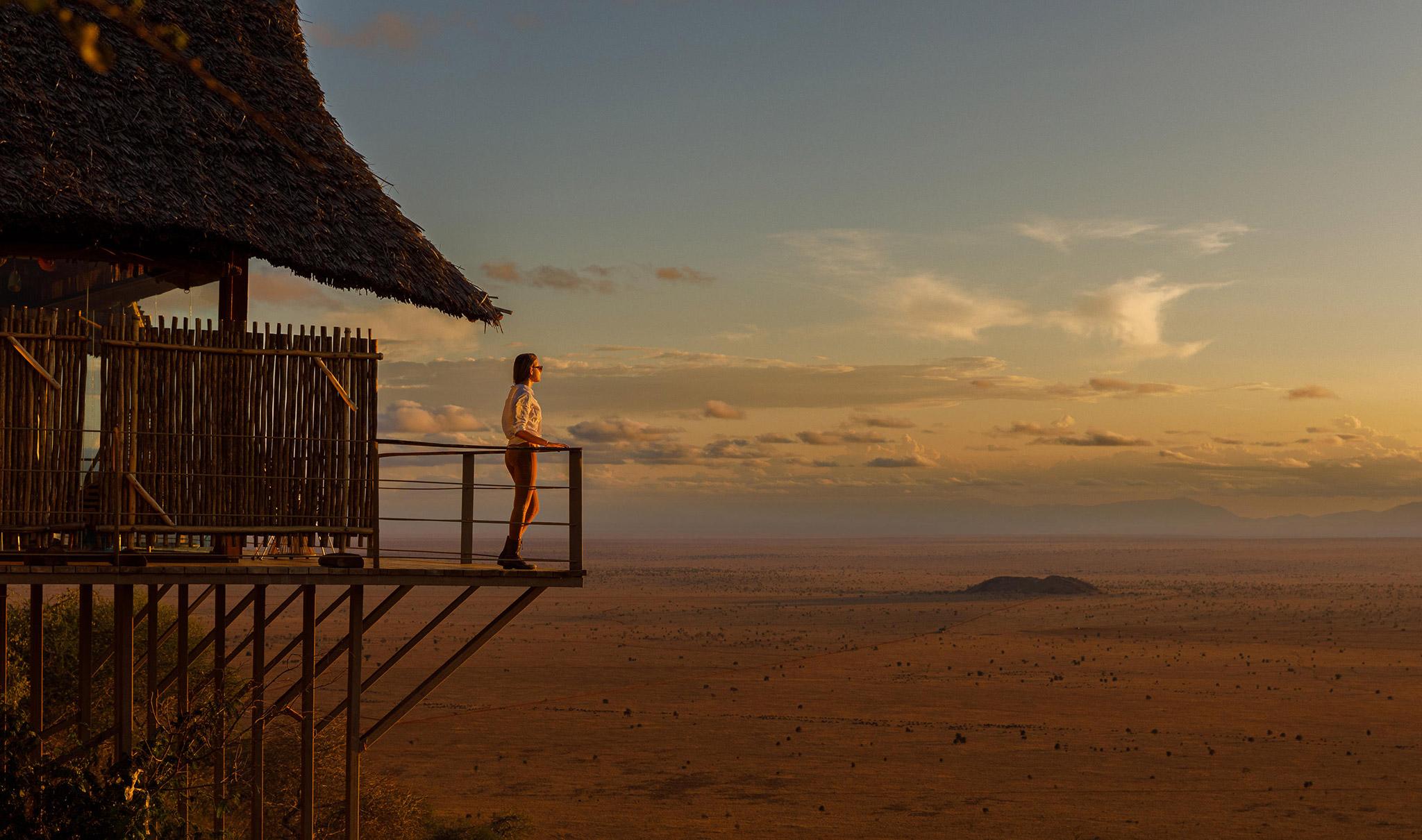
One evening, before we’d seen her, we had sundowners on a cliff above the river, genuinely spectacular scenery, Laikipia at its most cinematic, and I remember all of us being a little restless.
Beautiful as it was, we were there for one thing in particular, and we hadn’t found her yet.

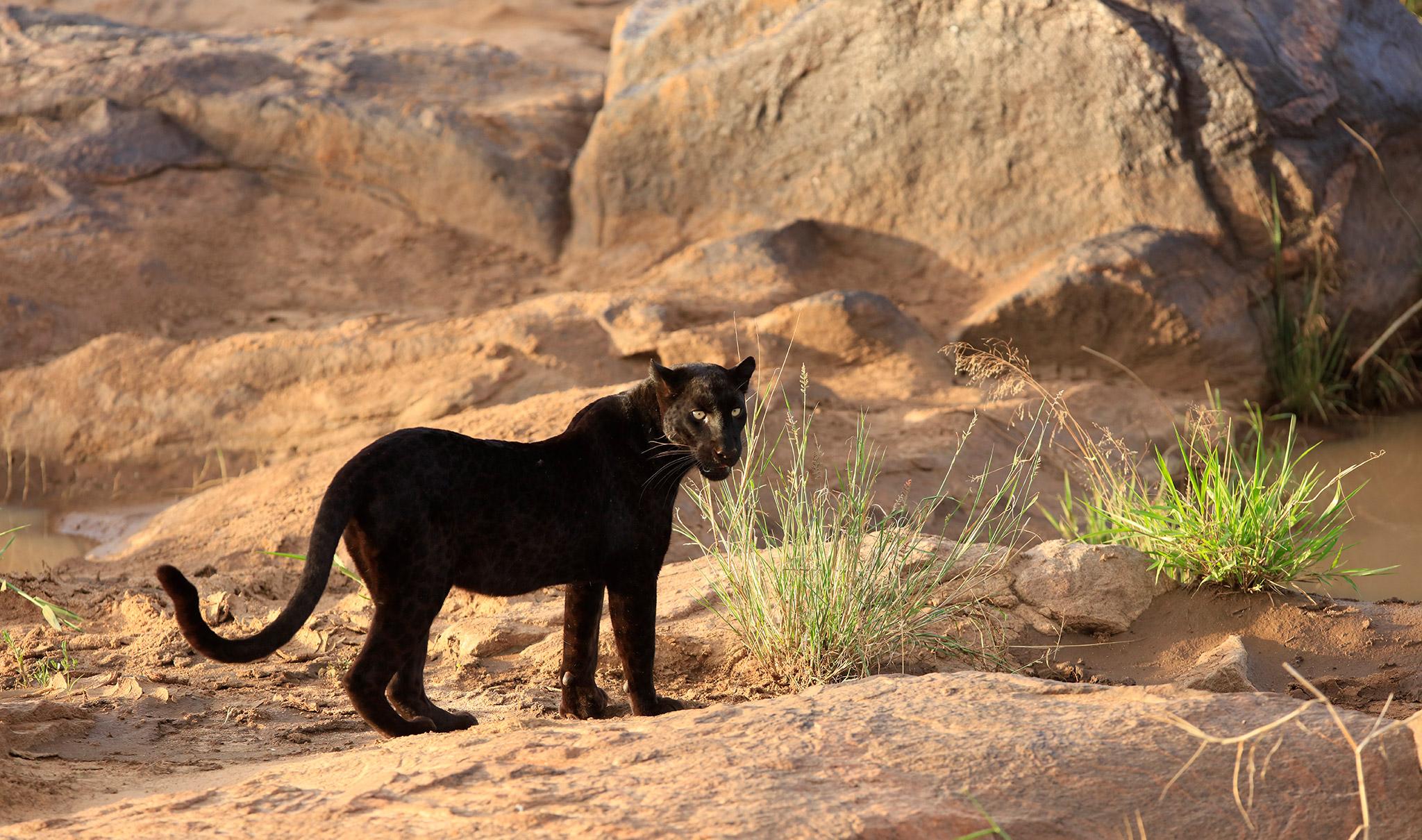
As the light started to fade, we went out for one more attempt. The best-known black leopard in Kenya is Giza, a female. The guides always have a rough sense of where she might be, not because she’s tracked or monitored around the clock, but because they know her patterns from years of experience with a wild, free-roaming animal on her own territory. This is the moment from the start of this story: driving back towards camp, we heard the alarm call, our guide said “Let’s try here,” and our tracker, up on the roof, spotted her.
Every one of us had seen plenty in our years of safari-going, and yet everyone went quiet and slightly tense with excitement, big smiles, but nobody wanted to be the one who spooked her. Up close, with the last of the light catching her coat, you could just make out the rosettes through the black, though from any distance she’d have simply looked solid black.
It was properly dusk by then. At Laikipia Wilderness, the camp we stayed at, spotlights are always fitted with red or green filters. White light is never used on her, hunting or not. And if she’s actually hunting, the guides switch the light off completely, so as not to draw the attention of larger leopards that could steal her kill. She’s smaller than average.
It’s one of many small details that told me the camp’s priority is genuinely her welfare, not just the guest experience.
Did I take a photo of Giza? Not a single one. It was one of those sightings that will simply stay with you forever and no photo I would manage to take would ever do it justice anyways.

What Is a Black Leopard, Really?
A black leopard is sometimes called a black panther, which is more of a nickname than a real species. It’s simply a leopard, Panthera pardus, exactly like any other, but with melanism, a genetic mutation that causes the coat to overproduce dark pigment.
In leopards, that comes from a recessive change in a gene called ASIP, which means a cub only ends up black if both parents carry the gene, and both happen to pass it on. Interestingly, in jaguars the same trait works the other way around: it’s dominant, not recessive, and comes from an entirely different gene, MC1R rather than ASIP.
Roughly 11% of leopards worldwide are melanistic, but the overwhelming majority live in the dense, moist forests of Southeast Asia and parts of South Asia, where a dark coat is thought to offer a camouflage advantage. That theory gets a little complicated in Laikipia, though, where the habitat is far more open than a rainforest. In Africa, it’s extremely rare either way, and Laikipia is one of the very few places you can reliably see it.

Is a Black Leopard in Kenya a Separate Species?
No, a black leopard is not a separate species. It’s the same species, Panthera pardus, with the same behaviour and territory instincts as any other leopard. The rosettes barely visible through her coat are the clearest proof of that: it’s a different coat colour, not a different animal.
Why Are Some Leopards in Kenya Black?
Some leopards in Kenya are black purely by chance: that recessive gene has been carried and passed down through a small number of individuals living in this particular part of Kenya.
What’s unusual is that this population is being actively documented and appears to be thriving, rather than staying at the level of rumour and folklore, which is where most black leopard sightings elsewhere in Africa have stayed.
Why Laikipia? Ol Donyo Lomboro Conservancy and the Making of a Famous Black Leopard
The world only really discovered this population in 2019, when British wildlife photographer Will Burrard-Lucas set up camera traps near Laikipia Wilderness Camp, chasing what he’d assumed was little more than local legend.
What came back was the first high-quality photographic evidence of a wild black leopard in Africa in close to a century, and the images went around the world.
While Giza, born and raised barely a stone’s throw from camp, is the most famous black leopard in Kenya, she isn’t the only one. Multiple individuals have since been documented across the wider Laikipia region.
I asked our guide the obvious question: why here, of all places? His answer was one of my favourite pieces of trivia from the whole trip. This particular stretch of Kenya, Ol Donyo Lomboro Conservancy, sits at a transition zone between the ranges of two different dik-dik antelope populations. One of them is a hardy type more usually associated with the harsh, arid conditions further north, around Turkana. Here, in far gentler conditions, that same dik-dik breeds prolifically.
More dik-dik means more food, closer together, which means leopards don’t need to defend huge territories to survive. Smaller territories packed into the same space add up to an unusually high density of leopards, golden and black alike.

Where Can You See a Black Leopard in Kenya?
The best place to see a black leopard in Kenya is Ol Donyo Lomboro Conservancy in Laikipia. There have been occasional reports from the thick forest of the Aberdares further south, but nothing with anywhere near the consistency, or the guiding expertise, that’s built up around Laikipia over the past several years.
It’s remote in a way that’s easy to say and harder to grasp until you’re there: there’s no phone signal at Camp, and the drive in is rough enough that flying is the sensible option.
Can a Sighting Be Guaranteed?
No, a black leopard sighting can never be fully guaranteed, and I’d be wary of anyone who tells you otherwise. It’s not a zoo.
But the odds are very good, thanks entirely to how well the guides know her behaviour and territory. Laikipia Wilderness runs a formal system where you can book a seat on a dedicated black leopard vehicle for priority access at any sighting, alongside a strict, small cap on how many vehicles are allowed at one time, to protect her.
We were lucky with the quieter January season and never had to wait our turn.
Beyond the Black Leopard: What Else Laikipia Offers
If I’m honest, the black leopard is the reason most people come, but it shouldn’t be the only reason you go. Golden leopards here are almost as much of a highlight, and we had genuinely exceptional lion and elephant sightings too.
For repeat safari-goers looking for something beyond the classic circuit, Laikipia’s combination of remote, private conservancy access and consistently excellent guiding is worth the trip on its own.
The black leopard is simply the extraordinary bonus.
Where to Stay: Laikipia Wilderness, River Camp
We stayed at River Camp, and I’d happily go back. It’s not over-the-top luxury. It’s authentic, family-style, and usually booked exclusively for your own group. The rooms are spacious individual cottages, each with an open-air outdoor bathroom. One morning, the team lit us a campfire before our early game drive, which I thought was a lovely touch. Most camps only do this in the evening.
If you’re travelling as a couple or pair rather than an exclusive group, you don’t need to book the whole camp. A single room at Laikipia Wilderness’s Main Camp works just as well, and still puts you inside Giza’s territory.
Planning Your Own Black Leopard Safari
Getting there by road is a genuinely tough drive, so flying in is what I’d recommend. Once you’re there, it’s easy to combine Ol Donyo Lomboro with other conservancies nearby for a longer, privately guided itinerary.
If I were you, I’d aim for January through March, one of the better shoulder seasons for the wider region, with fewer visitors and excellent conditions for photography.
Whatever time of year you choose, go in with the right expectations: this is a genuinely wild animal on her own terms, not a guaranteed photo opportunity.
That’s precisely what makes finding her feel the way it does. Let’s plan your black leopard safari in Kenya!
Author: Alexander Meinzingen