on Google


Ask me where my safari story really began, and I won’t say the Masai Mara. I’ll say Tsavo.
I was six years old, on my first big family safari through Kenya, when Tsavo left a mark on me that has never faded.
I’ve been fortunate enough to go on safari in nearly all of Kenya’s parks, including the best-known: the Maasai Mara and Amboseli. But nothing else looks, feels, or stays with you quite like Tsavo.
So if I was arranging a safari for friends or family, I’d add Tsavo to their itinerary without a second thought. Here’s why.
Why Tsavo Is the Missing Link in Your Kenya Safari
Here’s the thing about a first Kenya safari: the Mara is unmissable, and Amboseli isn’t far behind, home to one of Africa’s most iconic images: elephants ambling against the backdrop of Kilimanjaro.
But finishing there and flying straight home skips the part of Kenya I love telling people about.
Tsavo is the link, geographically and experientially, between the classic Southern safari circuit and Kenya’s south coast.
Drive from the Mara to Lake Naivasha, on to Amboseli, then into Tsavo. Instead of turning back towards Nairobi, you simply keep driving through Tsavo, bypassing busy Mombasa, and finally arrive at Diani Beach and its seventeen kilometres of pristine white sand.
Fly into Nairobi, then out of Mombasa – a wonderfully convenient way to end the trip, from bush to beach, savannah to sea.
If that sounds like your kind of trip, you can see the full itinerary on our Savannah and Sea safari page. Otherwise, read on, because Tsavo deserves an introduction of its own first.

A Landscape Like Nowhere Else in Southern Kenya
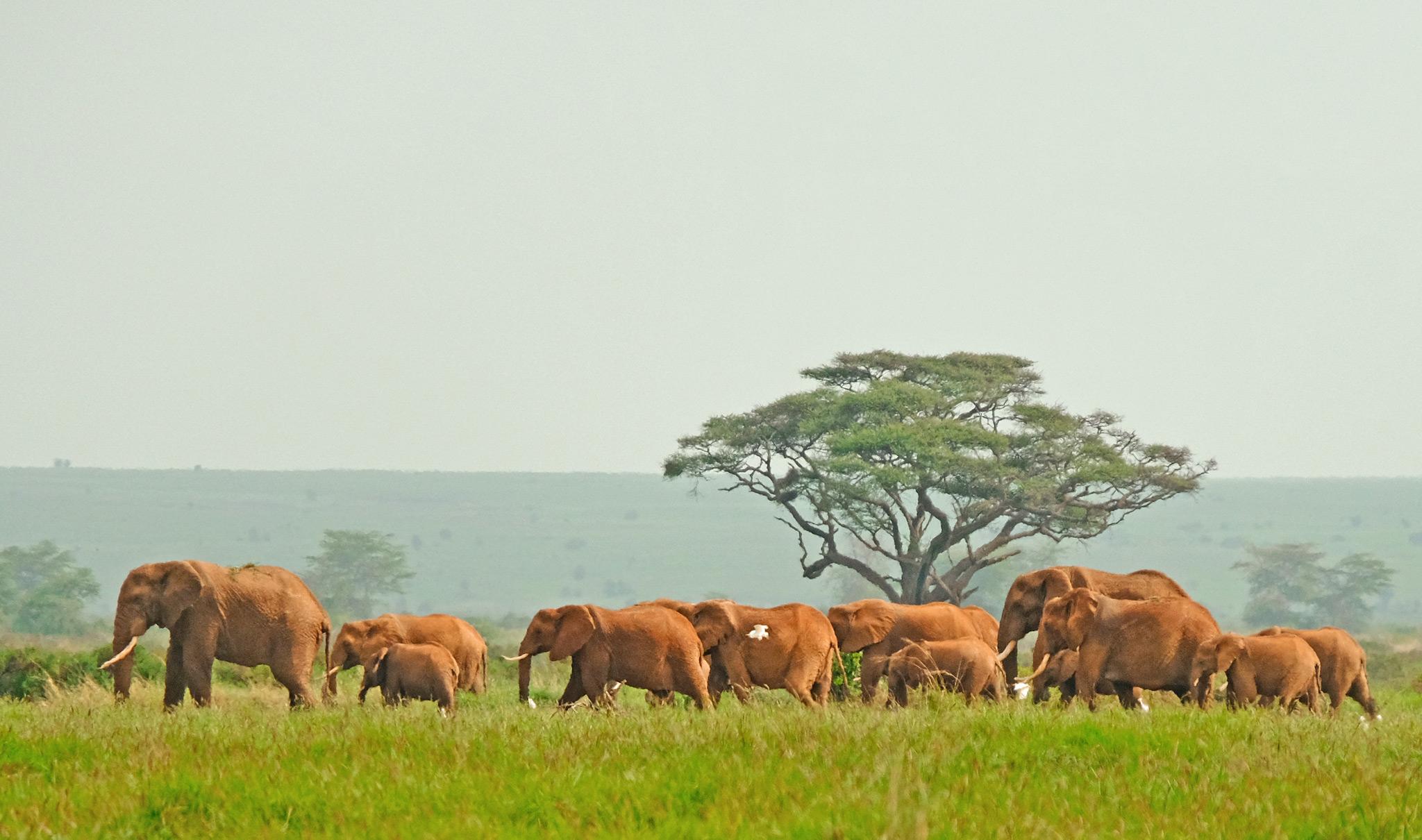
Tsavo is semi-arid: hot, dry, and dusted everywhere in a fine, ochre-red soil that coats the grass, the rocks, the vehicles, and, most memorably, the elephants and the maneless lions.
It’s the colour I remember most from that first trip: a whole landscape washed in warm red-gold, unlike the green plains of the Mara I’d see later on the same safari.
Together, Tsavo East and Tsavo West form Kenya’s largest national park, split by the Nairobi-Mombasa highway and railway.
It’s really the rivers, waterholes and springs, like Mzima, that give the park its lifeblood, drawing wildlife in from miles around to drink, wallow and cool off.
Visit any one of these water sources on a game drive, and you’ll cross wide elephant tracks worn into the earth, leading down to the water and away again.
The World’s Longest Lava Flow
On the western edge of Tsavo East runs the Yatta Plateau: at 290 kilometres, the longest lava flow on the planet, laid down by an ancient eruption on Ol Doinyo Sabuk mountain.
Driving alongside it is humbling. It makes you realise just how old this landscape really is.
A Land Layered in History
There’s evidence of rock art along the Galana River, and coastal traders are believed to have bartered ivory here as far back as the 8th century.
Centuries later, in 1898, two lions near Voi brought construction of the Nairobi-Mombasa railway to a standstill: the infamous “man-eaters of Tsavo,” later immortalised in the film The Ghost and the Darkness.
It’s a small footnote in a much bigger story, but stand on that same stretch of track today, and it’s easy to believe every word.

Tsavo’s Ochre Giants: An Elephant Comeback Story
If you love elephants, Tsavo is where I’d send you, and I say that having watched them across numerous parks in East Africa.
Around 12,500 elephants now move through the wider Tsavo-Mkomazi ecosystem, migrating between northern Tsavo, down through Tsavo East and Tsavo West, and on into Mkomazi National Park across the border in Tanzania.
Their skin is stained the same ochre-red as the soil they dust themselves in, protection against the sun and biting insects, and from a distance they look almost carved from the landscape itself.
It wasn’t always this way. Back in the 1960s and 70s, Tsavo’s elephant population stood at around 35,000, before poaching devastated it through the 1970s and 80s.
What’s exciting is that the trend has finally turned, and numbers are slowly climbing again.
From Nairobi’s Orphans to Tsavo’s Wild Herds
If elephants are your favourite animal and I was planning a unique safari for you, I’d start in Nairobi at the Sheldrick Wildlife Trust, watching the orphaned elephant calves being hand-fed at their morning mud bath.
I’d then make sure you spent a night in Tsavo East, close to the Trust’s Voi and Ithumba reintegration units, where those same orphans take their first steps back into the wild: one of the most moving elephant encounters in Kenya.
Worth knowing, again: this is one for a private, tailor-made safari rather than our small-group Savannah and Sea departures, which cover Tsavo West.
It’s one of Kenya’s great conservation stories. David Sheldrick was Tsavo East’s first warden, appointed in 1948, and after his death in 1977, his wife, Daphne, founded the Trust in his memory. You can read it in full in her bestselling memoir, Love, Life, and Elephants.
You can even stay at one of the Trust’s own tented camps on the banks of the Galana River. Bring your own food, and they’ll cook it for you: a low-impact way to spend a night in Tsavo.

A Different Kind of Wildlife Encounter
The lions are what stayed with me from that first safari: early one morning on a game drive, we came across two young males, maneless, thinner and smaller than the big-maned lions I’d later see in the Mara.
Tsavo’s lions live a harder life than their Mara cousins, and it shows in the way they look at you. They hold your gaze, steady and searching, as if they’re seeing a human for the very first time, deciding whether you’re a threat or a meal.
I can still remember looking into their eyes and instantly feeling the danger, an experience etched into my mind.
It’s this unhabituated reaction that makes a wildlife encounter in Tsavo so special. The wildlife, unaccustomed to many visitors, feels really wild, and you get a glimpse of what the people who first lived there must have experienced.
The Big Four (and a Shy Rhino Sanctuary)
Tsavo gives you a strong shot at the Big Four: lion, elephant, buffalo and leopard.
Rhino is the exception. Black rhino once thrived here, but poaching hit them hard, and sightings in Tsavo East are rare today.
The Ngulia Rhino Sanctuary, in Tsavo West, is where you’ll find them: home to more than a hundred black rhino today.
Combine both parks on your safari, and the Big Four may become the Big Five.
Rare Species and Remarkable Birds
What really sets Tsavo apart, for me, is the semi-arid wildlife: the striking Somali ostrich, the long-necked gerenuk balancing on its hind legs to browse, and the fringe-eared oryx.
Look closer, and you might spot the hirola: one of Africa’s most endangered antelopes, with pale “spectacles” around the eyes that earn it the nickname four-eyed antelope. Fewer than 500 remain, nearly all of them here in Tsavo.
Tsavo is also one of the best places in Kenya to see African wild dogs, whose numbers are slowly recovering in both Tsavo East and Tsavo West.
A sighting is rare and genuinely thrilling. Their coordinated hunts, tight family bonds and beautifully mottled coats make every encounter feel like a privilege you won’t forget.
With around 500 recorded bird species, it’s a genuine birder’s park too, and flashes of colour cross your path constantly: birds darting low over the rivers and chasing each other between the trees. It’s a birdwatcher’s delight.
Keep an eye out for Von der Decken’s hornbills, whose bizarre nesting habits (the female seals herself into a hollow tree with mud, leaving just a slit to be fed through while she raises her chicks) are one of my favourite oddities of the bush.
You’ll see them so often, gliding from tree to tree at every turn, that they start to feel like Tsavo’s unofficial mascot, watching over your safari with curious intensity, as if it’s guarding a secret the bush isn’t quite ready to show you.

When to Go
Tsavo is at its best in Kenya’s dry season, roughly June through October and again in January and February.
Go earlier in the season, and you’ll still catch shades of green in the landscape. Leave it later, and the bush turns dusty and gold, pulling wildlife into ever tighter clusters around the rivers and waterholes, which makes game viewing easier the drier it gets.
If you’re travelling with a decent camera, put April and May in your diary instead.
It falls in Tsavo’s low, rainy season. On a clear day, Tsavo West rewards you with crisp views of Kilimanjaro above ochre tracks and black lava rock, framed by dramatic cumulonimbus clouds on the horizon.
It’s one of the most photogenic combinations I’ve found anywhere on a safari in Kenya.
Where We Love to Stay
I’d recommend spending time in both halves of Tsavo if your itinerary allows it. They feel like two entirely different parks.
Tsavo East: Satao Camp
In Tsavo East, our favourite is Satao Camp: a classic tented camp near the Voi River in the south.
Big, comfortable tents, warm staff, excellent food, and sundowners that are hard to beat.
Worth knowing: this is one for a private, tailor-made safari. Our small-group Savannah and Sea departures cover only Tsavo West.
Tsavo West: Severin Safari Camp
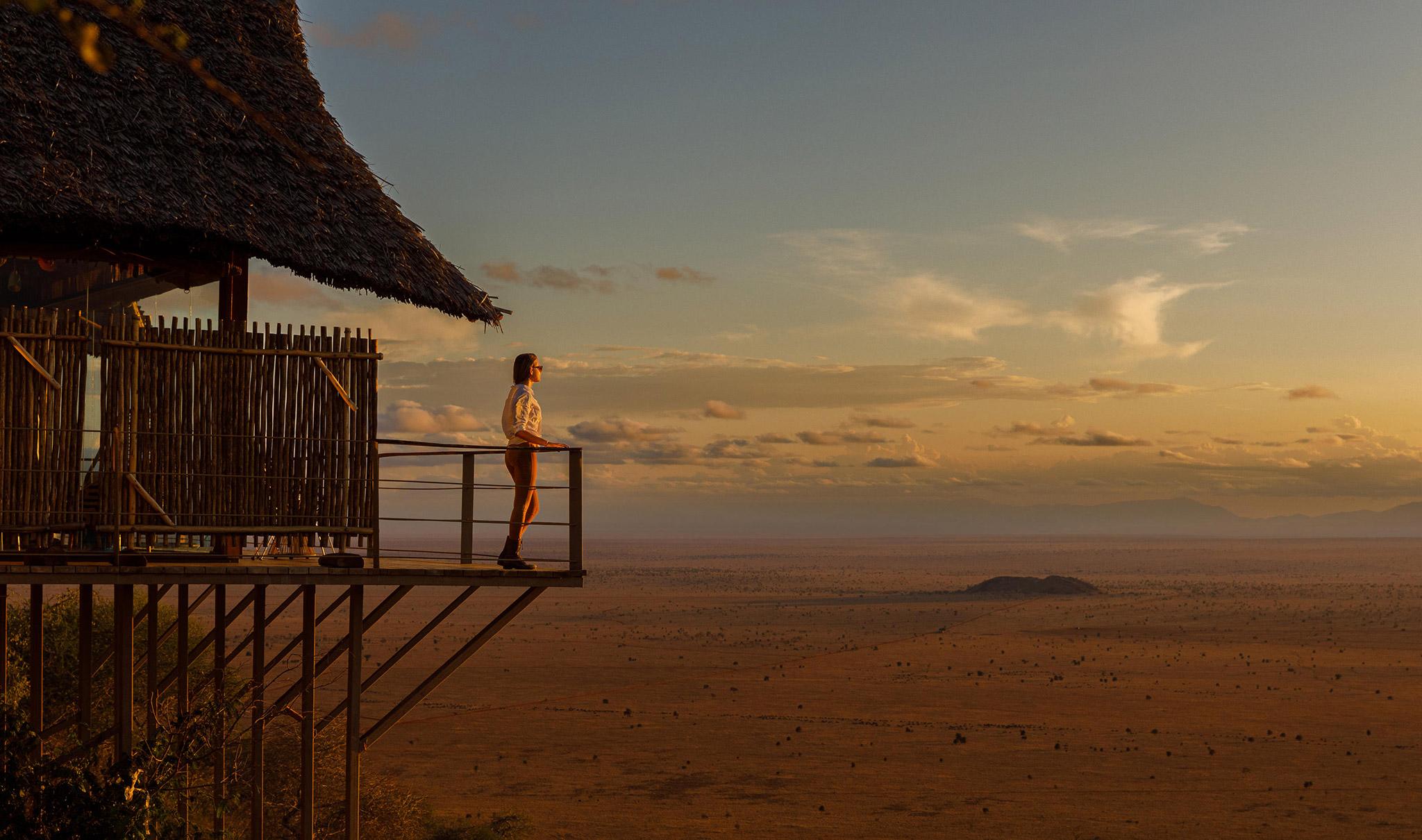
Over in Tsavo West, we love Severin Safari Camp: beautifully appointed en-suite tents, great food, and a location close to the volcanic scenery, the Tsavo River, the Ngulia Rhino Sanctuary and the dramatic backdrop of the Chyulu Hills.
If you can, take a walking safari with a Maasai guide while you’re there. Nobody reads the bush like they do, from animal tracks to medicinal plants.
I’ll never forget one walking safari where my guide stopped at two almost identical acacia trees. One, he explained, the bark treats diarrhoea. The other treats malaria. That’s the kind of insight you’d never find on your own.
And don’t skip sundowners at Poacher’s Lookout, just a short drive from camp.

Booking the Savannah and Sea Safari
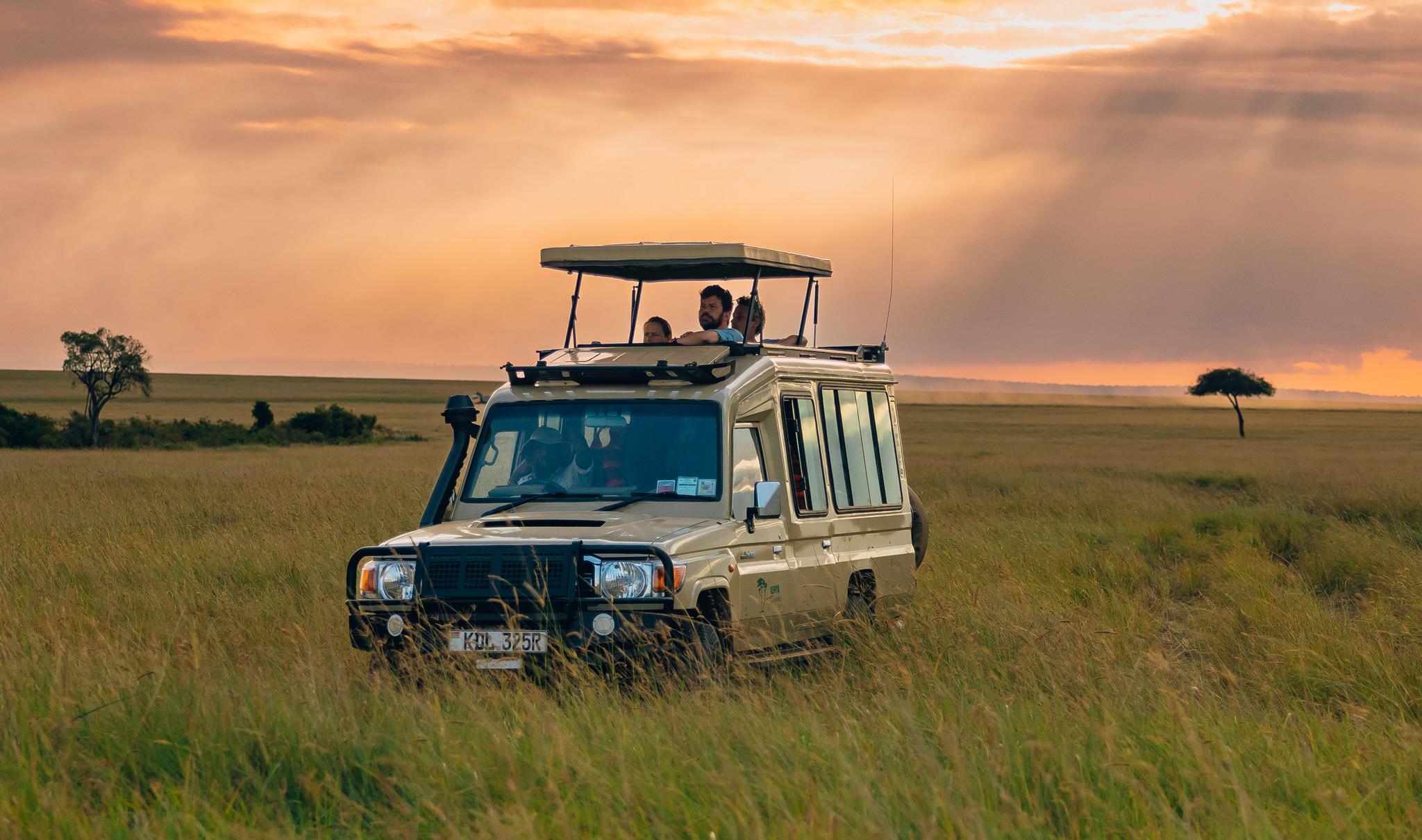
Our own Savannah and Sea Safari follows exactly this route: eight unhurried days from Nairobi through the Mara, Naivasha, Amboseli and Tsavo West, ending on Diani’s sand.
It’s a small-group tour, limited to seven, that feels like an authentic safari rather than a bus tour, and keeps costs down, with prices starting from $3,130 per person sharing for the full eight days.
Coastal nights are usually booked separately, but whether you’re on a group departure or a private safari, we can weave the whole thing into a single seamless safari-and-beach itinerary.
Favourite Tours:

Kenya – Savannah and Sea
Places Masai Mara National Reserve, Lake Naivasha, Amboseli National Park, Tsavo West National Park, ends in Diani Beach
from 3,130 USD per person sharing

Kenya Classic
Places Tsavo West National Park, Amboseli National Park, Lake Naivasha, Masai Mara National Reserve
from 2,400 USD (based on 7 persons)
Is Tsavo Right for You?
Couples and First-Timers
If this is your first trip to Africa and you’re travelling as a couple, I’d point you straight at the Savannah and Sea small-group safari.
It takes in Kenya’s best-known parks: the Mara, made famous by decades of wildlife documentaries, and Amboseli, home to one of the world’s longest-running elephant research projects.
Then Tsavo ties it all together and hands you over to the Swahili coast, where the waves do the rest.
Honeymoons and Families
Want more flexibility? The same route works beautifully as a private, tailor-made safari too.
On a honeymoon, I’d add a hot air balloon flight over the Mara and two to three nights at one of the Sheldrick Trust’s riverside camps in Tsavo: unique, romantic, and right on the river.
Travelling as a family, a private tour lets you add extra nights and choose family-friendly camps and lodges that welcome children, so there’s always a proper rest break for the kids.

Final Thoughts
Put simply, Tsavo tends to win over a specific kind of traveller.
With around 500 species, bird lovers should go. Elephant lovers will find the real draw here: the Sheldrick Trust’s conservation effort from nursery to release, and the herds of ochre-coloured giants themselves.
Landscape photographers belong in Tsavo West above all else. And if you love the idea of spotting a species most visitors to Kenya never see, the wild dogs alone make the detour worthwhile.
Wild, quiet, and utterly unlike anywhere else on a Kenya itinerary, that’s Tsavo: wildlife more diverse, birdlife for days, volcanic landscapes that demand to be photographed, and that ochre light and those maneless lions that have stuck with me since I was six years old.
If you’re planning your first safari in southern Kenya, don’t just visit the Mara and Amboseli. Add Tsavo, and let it carry you all the way to the coast.
That’s the trip I’d want for you.
We’re on the ground in Kenya, and our team can help you build this exact route, or adapt it to suit you. Get in touch for a no-obligation conversation about your Savannah and Sea safari.
Author: Alexander Meinzingen