on Google


From sweeping savannahs teeming with wildlife to bustling cities like Nairobi, Kenya is a country of remarkable contrasts and rich heritage that offers a vibrant blend of tradition and modernity.
While most people associate Kenya with safaris and the Great Migration, there is so much more to the country – a lot of which often goes unnoticed.
Did you for instance know that Kenya is one of the world’s leading tea exporters? Or that the term “safari” actually originated here? No? Then let us take you on a journey of some interesting facts about Kenya, that are equally unusual and interesting!
Kenya’s Tea Dominance Is Little-Known
Would you have guessed that Kenya is one of the world’s leading tea producers? While China ranks first, with India coming in second, it is neither Sri Lanka nor Malaysia taking the third place – it is indeed Kenya and while its influence in the tea industry may be little known, it is a force to be reckoned with.
With its robust flavour and bright colour, Kenyan tea is used in some of the most popular blends around the world. The country’s climate and elevation make it perfect for tea cultivation, particularly in the highlands of the Kenyan Rift Valley.
Mount Kilimanjaro Was Almost Kenyan
While there are many myths surrounding Mount Kilimanjaro, one of the more persistent ones suggests that Queen Victoria “gifted” Mount Kilimanjaro to Kaiser Wilhelm II, her German grandson.
According to said myth this would have been done by redrawing colonial borders in a way that ensured the mountain would fall within German East Africa – or modern-day Tanzania.
Reality, however, tells a different story: The borders between British and German spheres of influence were determined by formal treaties, such as the 1890 Heligoland–Zanzibar Agreement that granted Britain control over Zanzibar while Germany secured areas on the mainland, including what today is known as Tanzania – and with it Africa’s highest mountain, Kilimanjaro.
Umoja Village: A Women-Only Sanctuary
The village of Umoja, based in Samburu County, is a very special place: Founded by Samburu women it has served as a safe haven for women who have survived gender-based violence.
Operating entirely without men, the village champions female empowerment, self-sufficiency, and solidarity – and has gained international recognition as a symbol of resistance and resilience.
Residents earn a living through crafts and tourism, while raising awareness of harmful practices such as female genital mutilation and child marriage. Today, Umoja stands as a remarkable example of women reclaiming their rights and rewriting their futures.

Sirikwa Holes: Iron-Age Cattle Fortresses
Scattered across Kenya’s central Rift Valley are mysterious depressions in the earth known as Sirikwa holes. Dating from approximately 1200 to 1800 AD, these ancient sunken enclosures were once fortified cattle kraals used by pastoral communities in the Iron Age.
They are thought to be remnants of the Sirikwa people – ancestors of some modern-day Kalenjin communities – Today, they are surrounded by defensive fencing and sometimes living quarters,
These unique archaeological features reflect a highly organised form of livestock management and settlement planning. They offer a fascinating glimpse into Kenya’s early societies and their ingenious methods of cohabiting with their herds in challenging environments.
Renewables Power Over 90% of Kenya
One of the most interesting facts about Kenya is that the country is at the forefront of sustainable power generation – with more than 90% of its electricity derived from renewable sources.
Major hydroelectric, geothermal, wind and solar energy projects include the Olkaria geothermal fields and the Lake Turkana Wind Power plant – they are examples of how clean energy can drive national development, providing more stable and affordable energy for its people while reducing emissions.
In its efforts to work towards a more sustainable future, the country has also introduced a ban on single-use plastic, in effect since 2017.
Our Favorite Tours in Kenya:

Kenya – Savannah and Sea
Places Masai Mara National Reserve, Lake Naivasha, Amboseli National Park, Tsavo West National Park, ends in Diani Beach
from 3,130 USD per person sharing
Northern Kenya – Experience Remoteness
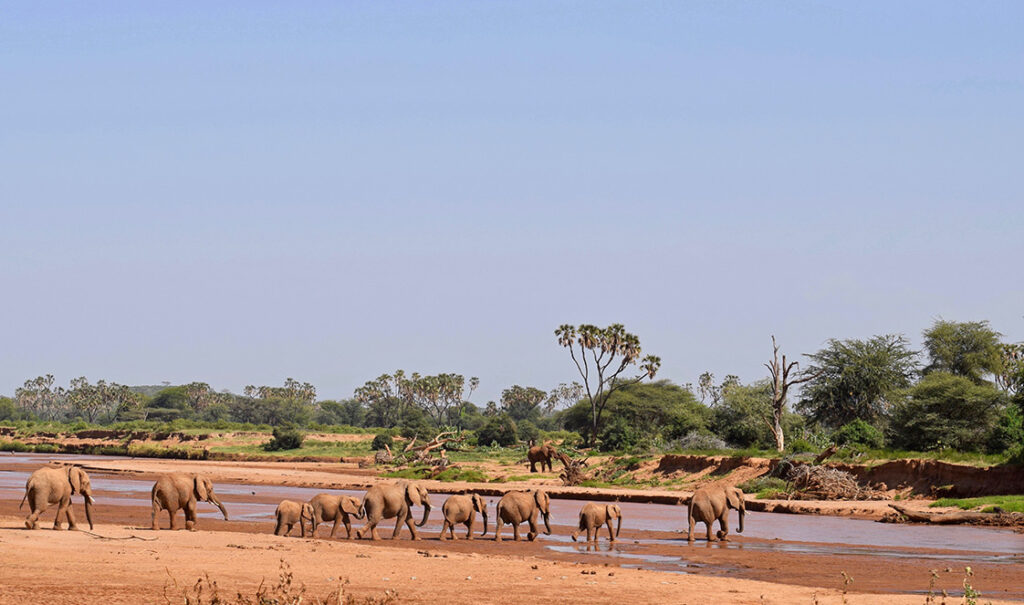
Places Solio Game Reserve, Samburu National Reserve, Ol Pejeta Conservancy
from 1,560 USD (based on 7 persons)
World’s Largest Desert Lake: Lake Turkana
Also known as the “Jade Sea” due to its striking colour, Lake Turkana is a surreal oasis in northern Kenya’s arid lands. Fed by the Omo River from Ethiopia, the world’s largest permanent desert lake supports an entire ecosystem in one of the harshest environments on earth.
Lake Turkana is also of immense paleoanthropological importance. Fossils found along its shores include a near-complete Homo erectus skeleton – known as the Turkana Boy – dating back 1.5 to 1.6 million years as well as a well-preserved elephant cranium, dating back an incredible 4.5 million years.
Home to large flocks of flamingos that create a striking contrast to its surroundings, Lake Turkana is a magnificent destination that is best viewed from the air. Want to see it for yourself? Get in touch to arrange an unforgettable helicopter flight over Lake Turkana.
Karen Blixen Helped Put Kenya on the Global Map – Literally
Out of Africa, a memoir by Danish author turned coffee farmer published in 1937, played a significant role in shaping international perceptions of Kenya.
Through her lyrical portrayal of colonial life and the Kenyan landscape, she introduced European and American readers to a romanticised vision of East Africa long before the nascent of the modern tourism industry. The memoir was made into a film of the same name, starring Meryl Streep and Robert Redford, which further ignited global interest in Kenya as a travel destination.
Blixen’s farm, which was once located outside Nairobi, is now Museum and lies within the city limits, in a suburb named Karen in the author’s honour. Offering a vivid glimpse into Kenya’s colonial past and literary history, the Karen Blixen museum is a highlight on the Classic Nairobi daytrip.
Lamu Island: Car-Free UNESCO Town
Dating back to the 12th century, Lamu Old Town is one of the oldest and best-preserved Swahili settlements in East Africa.
A UNESCO World Heritage Site, Lamu offers a rare glimpse into a bygone way of life, with winding alleyways, coral stone houses, and intricately carved wooden doors. It is the perfect escape for anyone looking for an island destination that combines beach with culture and history.
Lamu is entirely car-free, thus, transport here is by foot, donkey or dhow – the traditional Swahili sailing boat. Get in touch to plan your stay in Lamu – either in combination with a safari in one of Kenya’s many national parks or as a standalone beach holiday.

Missionary Johann Krapf Named Mount Kenya
German missionary Johann Ludwig Krapf is widely credited as the first European to document Mount Kenya in 1849. Guided by local knowledge, he recorded various indigenous names for the mountain, including “Kĩrĩnyaga”, which inspired the colonial name “Kenya”.
While Krapf played a key role in introducing both Mount Kenya and Mount Kilimanjaro to European audiences, he was also active in other fields: The missionary, who was also an explorer and linguist, compiled the first Kiswahili–English dictionary, significantly contributing to and shaping early European understanding of the region.
Interesting and Unusual Facts About Kenya – Part II
Our next interesting facts about Kenya are all about animals – from safaris on camel-back to man-eating and tree-climbing lions to proud elephants and where to find them.
Kenya Coined the Term “Safari”
The word “safari” originates from the Arabic term safar meaning “journey” and was later adopted into Swahili as safari.
British colonialists and 19th-century explorers then used it to describe their expeditions into the wilderness, shaping the romanticised notion of the African safari that today refers primarily to wildlife tours.
Kenya remains one of the world’s most iconic safari destinations, attracting tourists eager to witness the Big Five in their natural habitat. So here are some safari related interesting facts about Kenya:
Kenya is the Birthplace of Balloon Safaris
While helicopter flights may be your best option when visiting Lake Turkana, hot air balloons have become somewhat synonymous with safari experiences in Kenya.
This experience was pioneered by Alan and Joan Root who achieved the world’s first balloon flight over the summit of Mount Kilimanjaro in 1976. It was the “birth”, so to speak, of the hot air balloon safari, with the couple launching Kenya’s first balloon safaris not long after their record-breaking voyage.
The company is still in existence today, giving tourists a new and breathtaking way to witness the savannah and its inhabitants.
At Kenya Experience, we proudly use their services for our Masai Mara Balloon Safaris that take you for an unforgettable experience: Watch the savannah come to life as you silently drift above the plains during sunrise.

Tsavo’s Famous “Man-Eaters” Were Toothless
The notorious Man-Eaters of Tsavo were two male lions that terrorised railway workers in 1898 during the construction of the Kenya–Uganda railway. Unlike typical lions, they hunted humans – and scientists believe dental problems were to blame.
The pair’s skins and skulls and skins are now housed at the Field Museum in Chicago, where scientists have determined that one of lions had a fractured canine and an abscess, likely making it too painful to take down tougher prey.
Today, their former hunting grounds – Tsavo East and Tsavo West – are among Kenya’s most popular national parks – renowned and beloved for their scenic beauty, vast landscapes, and amazing wildlife encounters.
Kenya Hosts Some of the Last “Super Tuskers”
Tsavo is not only famous for its Man-Eaters but also for being home to some of Kenya’s last so-called Super Tuskers. With tusks so large they nearly touch the ground, those elephants are a dying breed and fewer than 20 of these magnificent creatures remain in all of Africa.
Apart from Tsavo, Amboseli National Park is another one of their last remaining strongholds where you get a rare chance to glimpse these giants in the wild.
Combining Tsavo’s red dust and elephants with Amboseli’s iconic views of Mount Kilimanjaro, the 8-day Savannah and Sea tour is a perfect option to see both parks in one journey.
Some Lions in Kenya Are Tree Climbers
Tree-climbing lions are most famously associated with Uganda, but some prides in Kenya also show this unusual behaviour.
It is a rare and remarkable sight that can be found in Lake Nakuru National Park and parts of the Maasai Mara, where lions have been known to rest in acacia branches or fig trees.
Rather than merely providing shelter from the sun, the reason for this behaviour is thought to help lions escape biting insects or gain a better vantage point for spotting potential prey.
Our Discover the Great Rift Valley tour includes both Lake Nakuru and the Maasai Mara – increasing your chances (though not a promise!) to witness this extraordinary feline behaviour.
Nairobi National Park: Wildlife in the City
Nairobi is the only capital city in the world that offers encounters with giraffes, zebras, elephants and even lions just outside its city limits. Just minutes from the city centre, Nairobi National Park is the place to go if you want the rare chance to see wild animals with skyscrapers as a backdrop.
The Big Five in Nairobi day trip is a perfect introduction to Kenya’s wildlife and conservation work, all within easy reach of your hotel or airport layover. It includes game viewing in the park as well as a visit to the Sheldrick Wildlife Trust, where orphaned elephants are cared for before being reintroduced into the wild.

You Can Go on a Camel Safari
Beyond the traditional 4×4 and quintessential hot air balloon rides, Kenya also offers camel safaris as a truly unique way to encounter the wild. Especially in Laikipia and parts of northern Kenya, guided camelback safaris allow you to explore remote landscapes at a slower pace.
Led by experienced Samburu or Maasai guides, these treks range from short walks to multi-day journeys across dry riverbeds and open savannah, with camels carrying your gear. This rare type of safari not only allows for intimate experiences and close wildlife encounters – above all, it is an enriching way to connect with both land and culture.
Interested? Get in touch for a tailor-made safari, and we’ll help you plan a camel safari that suits your style and pace for a once-in-a-lifetime adventure.
Final thoughts – Why These Stories Matter
While these interesting and unusual facts about Kenya reveal sides that travellers often miss, one thing becomes clear: From Super Tuskers to camel safaris, from ancient towns to forward-thinking energy efforts, Kenya offers more than just postcard moments.
They serve as reminders of what makes travel meaningful: deep connections, rare encounters, and respect for nature and heritage.
By choosing thoughtfully curated tours, the money you spend on holiday helps protect wild places and contributes to local economies.
Let your journey be more than a holiday – let it be a story worth telling and get in touch to learn more about your options for a truly immersive experience.
Author: Christina Leitner